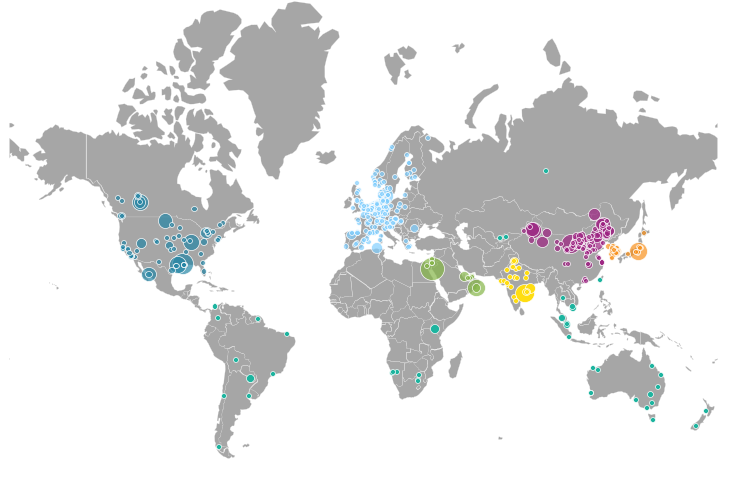
The first wave of mature clean hydrogen projects is coming online. Today, about $110 billion in committed investment supports more than 500 projects past final investment decision, in construction or operation across the globe – up $35 billion in the past year alone. In just five years, our sector has scaled at remarkable pace, with investment growing over 50% year-over-year. The total committed capacity now exceeds 6 million tonnes per year (mtpa), of which 1 mtpa is already operational.
But this progress has not come without turbulence. The sector is navigating through the hype cycle and moving from a surge of announcements in 2022–2023 to a more disciplined era of maturation, similar to the solar, wind, and battery industries. Over 1,700 projects have been announced globally since 2020, a 7.5 increase, but a pipeline clean up is underway – a natural attrition phase where the projects with the strongest business cases get selected, win regulatory support, and close financing, while projects that lacked commercial viability inevitably get cancelled. A challenging macroeconomic environment with structurally higher interest rates, elevated energy and equipment costs, and delayed implementation of climate policies in some regions is exacerbating this selection process.
What is emerging is a stronger, more credible foundation of projects built on solid business cases and growing offtake certainty. Including the projects that are already committed, the current supply pipeline could support a total of 9-14 mtpa by 2030. However, how much of that capacity materializes still hinges on demand and only those projects that secure offtake will ultimately come online.
Demand is our next great test. Roughly 3.6 mtpa of binding offtake has been secured globally. In key markets such as the EU, US, Japan, and Korea, implementation and enforcement of existing policies could enable a total of up to 8 mtpa of clean hydrogen demand by 2030, although there is still more work to do. A further 13 mtpa could be unlocked through targeted infrastructure investment and continued cost reductions, but without timely implementation, much of the supply opportunity will remain unfulfilled.
CEOs from Hydrogen Council member companies who were interviewed in preparation for this report acknowledged that the environment remains challenging for clean hydrogen, but shared a sense of optimism, particularly those leaders accustomed to the development cycles that come with large-scale industrial sectors. Leaders also pointed to demand, backed up by policy stability, as the lynch pin for future growth, with most anticipating additional regulatory clarity in the near term.
Realism, pragmatism and focus will be key to success in the next phase of hydrogen build-out. We are therefore proud to introduce this inaugural Global Hydrogen Compass – a unique report that provides much needed clarity on what is really happening in hydrogen through a combination of comprehensive industry data, direct insights from global CEO leaders, and case examples of projects that demonstrate what it takes to progress despite a challenging environment. Like a compass, we hope it will guide business, policy and other decision-makers through this pivotal moment in our important collective effort to build a clean, secure, and resilient energy future.
CEO, Linde
Vice Chair, Hyundai Motor Group
About 2.2 mtpa of low-carbon capacity is committed in North America (85% of the global total). US production in particular is enabled by structural advantages including low-cost natural gas, existing CCS and export infrastructure, and supportive policy (e.g., the 45Q CCS tax credit). Most US low-carbon volumes are expected to serve exports in the near term given uncertainty around or limited availability of domestic demand-enabling policies (e.g., LCFS). Renewable capacity in the US has been curtailed due to a shortened eligibility timeline for the 45V production tax credit. Meanwhile 97% of Canada’s committed capacity is low-carbon, but significant wind resources could be harnessed for renewable production for export.
Europe ranks third in committed investment (USD 19 billion), while accounting for nearly two thirds of expected 2030 global demand. By 2030, nearly 5 mtpa of clean hydrogen demand could emerge if policies like the Renewable Energy Directive (RED) III and the Carbon Border Adjustment Mechanism (CBAM) are implemented alongside the Emissions Trading Scheme (ETS). The EU is expected to supply near-term demand locally via small to mid-size projects before transitioning to a net importer, assuming trade infrastructure falls into place. In the last year, committed capacity has doubled as early signs of regulatory clarity emerge (e.g., RED III transposition drafts for transport), but firmness of potential demand still hinges on full policy implementation (e.g., for RED III industry targets).
China currently accounts for 19 GW (1.6 mtpa) of committed renewable hydrogen capacity (approximately 55% of global), with Chinese projects in some cases four to ten times larger than European and American renewables projects. Supply predominately serves growing domestic demand on the back of a push to diversify away from dependence on fossil-based energy sources.. Current offtake is focused in ammonia, refining, and power with growing deployment of commercial fuel cell vehicles. Top-down policy directives, centrally-supported lower cost of capital, and strategic alignment of state-owned enterprises appear to contribute to rapid growth in the sector.
Nearly all of India’s committed renewable hydrogen investment is dedicated to ammonia production projects, bolstering its already substantial base of domestic ammonia production. India has set record low renewable ammonia prices in recent Solar Energy Corporation of India (SECI) auctions under the National Green Hydrogen Mission’s (NGHM) Strategic Interventions for Green Hydrogen Transition (SIGHT) scheme, which could position India as a potential exporter of ammonia although the domestic fertilizer market is a likely offtake vector in part to alleviate reliance on imports.
The 0.5 mtpa of committed capacity across Middle Eastern countries is split 55% renewable, 45% low-carbon. Low-cost renewable energy, advantageous access to financing, and a focus on large-scale projects enable globally competitive renewable hydrogen production costs, positioning the region as a key exporter. Abundant natural gas resources could also enable competitive low-carbon exports, however, energy diversification and budding demand in Europe appear to be driving current renewable hydrogen investment.
Although South American countries have limited committed capacity, a growing pipeline of earlier stage projects, of which 98% are renewable, is enabled by abundant renewable resources including hydro-power in Brazil and Paraguay, and solar and wind in Chile and Argentina. Hydrogen policy frameworks like Chile’s National Green Hydrogen Strategy set ambitious production and export targets and Brazil’s National Hydrogen Program (PNH₂) provides a strategic roadmap across six pillars to accelerate clean hydrogen development.
Approximately 50% of committed investment in Oceania is directed towards renewable hydrogen production projects. However, with limited demand centers in Oceania, realizing the region’s production potential depends on establishing international trade infrastructure. While many large-scale projects remain in the feasibility stage, policy support and financing mechanisms, such as Australia’s recently passed Hydrogen Production Tax Incentive beginning in 2027, create a strong foundation for future progress.
Project pipeline maturation has led to a growing foundation of capacity with a compelling business case while natural attrition has begun to streamline the earlier-stage funnel.
Further maturation of the pipeline is anticipated: about 7 mtpa of capacity is currently in FEED with 16 mtpa more in feasibility, of which approximately 3-8 mtpa could still move forward by 2030 if it secures offtake.
In addition to ongoing pipeline cleanup, the composition of new announcements may continue to shift toward more infrastructure projects and end use segments as early trade routes materialize.
For renewable hydrogen projects, compounding cost factors have forced operators to streamline designs, focus on addressing costs outside of electrolyzer systems, and find creative operating models that maximize resource use and revenue streams.
For low-carbon projects, finding the right combination of low-cost natural gas, existing CCS networks, access to trade infrastructure and supportive policy landscape has helped regions like the US Gulf Coast emerge as hotbeds of development.
Looking ahead, Chinese electrolysis deployment is expected to continue at pace. The US and Canada appear likely to remain positioned as the low-carbon leaders in the near term. Low-cost renewable ammonia exports may emerge from India, the Middle East and other regions with abundant renewable resources.
Emerging policies have created initial demand signals (e.g., RED III, ETS, Japan’s CfD, Korea’s CHPS) with offtake momentum already anticipating enactment of these policies, but the overall business case for clean hydrogen continues to hinge on the stability and implementation of these policies.
Commercialization of hydrogen end uses would likely be sequenced going forward, starting with existing end uses (which comprises the majority of emerging demand so far). New end uses could gain more traction as the industry scales, benefitting from anticipated cost-down and the emergence of additional infrastructure.
A few questions remain that could shape future uptake of clean hydrogen, including whether demand generated through current regulation is sufficient to catalyze growth beyond decarbonization of existing end uses, how downstream end-user activation will influence upstream competitiveness across new sectors, and how emerging demand will be most economically served, potentially on the back of new infrastructure.
The operational Kassø e-methanol plant is the world’s first large-scale e-methanol plant operated by European Energy. It produces up to 42 kt annually, powered by 52.5 MW of electrolyzers using renewable electricity from the co-located 304 MWp Kassø Solar Park and the public grid. It utilizes 60,000 t/year of biogenic CO₂ from nearby Tønder Biogas and operates with Clariant’s MegaMax 900 catalysts.
Both the location and technological design of the plant optimizes for whole system efficiency on both inputs and outputs.
A co-located 304 MW solar park by European Energy supplies about half the plant’s electricity, complemented by wind power. A power balancing trading partnership with Danish Commodities optimizes the cost efficiency of the plant through real-time electricity market optimization of both the solar park and e-methanol production facility and ensures stable, continuous production. The plant also utilizes 60 kt/year of biogenic CO₂ from nearby Tønder Biogas plant, significantly cutting its carbon intensity compared to fossil methanol.
On the plant outputs, the exothermic methanol synthesis generates excess heat, which is used to supply district heating and boosting project economics through an additional revenue stream.
The Air Liquide Normand’Hy project showcases a holistic and collaborative model for developing large-scale renewable hydrogen ecosystems in Europe, leveraging Europe’s Renewable Energy Directive and funding under Europe’s IPCEI programme. The 200MW electrolyser technology features state-of-the-art electrolyzer stacks from Air Liquide’s 25:75 gigafactory joint venture with Siemens Energy.
The project’s viability is anchored by structured, long-term offtake contracts with key partners:
The fully integrated renewable hydrogen-to-steel plant in Boden, Sweden will feature a 740 MW electrolyzer, direct reduced iron process, and electric arc furnaces to produce up to 2.5 mtpa of renewable steel by 2026. The plant achieves ~95% CO₂ emission reduction compared to traditional blast furnace methods and has plans to scale to ~5 mtpa by 2030. Stegra partners with leading technology partners such as SMS Group, Siemens, and thyssenkrupp Nucera to supply key plant components.
Stegra has structured offtake agreements not only to purchase renewable steel, but also to integrate a circular supply of steel scrap back into their process in a pioneering method to create strategic feedstock security and reduce the need for virgin iron ore. Multi-year binding offtake agreements with major companies like Kirchoff Automotive include provisions that scrap is returned to the Boden plant for recycling, which supports both resource efficiency and reduces overall lifecycle emissions.
NGHC is a renewable hydrogen project in Saudi Arabia, located in Oxagon in NEOM. It is a $8.4 billion joint venture between Air Products, ACWA Power, and NEOM. The project aims to produce 600 MT/day of renewable hydrogen by 2027 using 4 GW of renewable solar and wind power. The hydrogen will be converted into ammonia for global export, especially to Europe and Asia. This project is one of the largest renewable hydrogen projects globally and central to Saudi Arabia’s Vision 2030. In the beginning of June, NGHC announced it reached 80% construction completion at the start of Q1 2025 across all project sites — the renewable hydrogen facility, wind garden, solar farm, and transmission grid.
This project represents a breakthrough in sustainable energy finance at a total investment value of $8.4 billion. The project utilizes an innovative non-recourse financing framework pooling funding from 23 lenders, which has been certified by S&P Global as adhering to green loan principles and is one of the largest project financings under the green loan framework. Additional equity financing is provided by NEOM, ACWA Power, and Air Products JV NEOM Green Hydrogen Company. The large investment is anchored by Air Products 30-year exclusive offtake agreement to provide revenue certainty and align interests, as Air Products is also the main EPC contractor. Air Products is planning to sell the majority of the ammonia to other parties for its ultimate end-use.
The Sinopec Kuqa Green Hydrogen project features a 300 MW solar PV array to directly power the electrolysis plant capable of producing ~20 ktpa of renewable hydrogen. It is the world’s largest PV-powered renewable hydrogen site with on-site hydrogen storage and pipeline connection to Sinopec’s downstream Tahe Refining & Chemical plant.
Blue Point will produce approximately 1.4 million metric tons of low-carbon ammonia per year in the U.S. Gulf Coast and is projected to start operations in 2029. The project will leverage CCUS processes to permanently sequester approximately 2.3 million metric tons of CO₂ per year, reducing CO₂ emissions by more than 95% compared to conventional ammonia production methods.
CF Industries, the world’s largest producer of ammonia and a global leader in the production of low-carbon ammonia, JERA, Japan’s largest power generation company, and Mitsui, one of the country’s leading trading companies with 50 years of ammonia trading experience and the top market share in Japan, are jointly developing one of the largest low-carbon ammonia production projects in the world.
The project will have deep-water access along the U.S. Gulf Coast and CF Industries will bring critical project development and operational expertise. The project is leveraging industry-leading firms for engineering, procurement, industrial gas supply, CO₂ transport & sequestration to reduce project execution risk.
Roadrunner will be the largest North American owner-to-Liquids facility. The project is in construction today, and will be the first installation of HYPRPlant, Electric Hydrogen’s American-made standardized 100MW PEM electrolysis plant. HYPRPlant reduces total installed project costs of the hydrogen electrolysis plant by up to 60% compared to commercially-available alternatives. The Roadrunner project will use waste CO₂ and low-cost renewable hydrogen to create approximately 23,000 metric tonnes per year of eSAF, plus eDiesel and eNaphtha.
IAG (parent company of British Airways) signed a 10-year offtake agreement with Infinium for 1/3 of the project’s annual capacity in order to comply with the UK SAF mandate (requiring 10% sourcing of sustainable feedstocks by 2030). American Airlines has signed a separate long-term offtake agreement and will transfer the associated emission reductions credits to Citi to reduce Citi’s Scope 3 emissions associated with employee travel. The novel offtake commitments demonstrate a substantive collaboration that supports project financing by providing revenue certainty for the project.
Brookfield Asset Management, a leading global infrastructure investment firm, has provided equity investment to the Roadrunner project alongside Breakthrough Energy Catalyst. HSBC, one of the world’s largest banking and financial services organizations, is providing debt financing for the project.
Dow’s Path2Zero project retrofits and expands its existing site in Fort Saskatchewan to become the world’s first net-zero Scope 1&2 emissions site, which upon full completion of all phases is expected to supply approximately 3.2 mtpa of certified low carbon emissions polyethylene and ethylene derivatives. Under a binding long-term supply agreement, Linde will deliver the necessary low-carbon gases as part of the initial phase of the project, including the recovery of hydrogen from Dow’s cracker off-gas.
Among other retrofits to the Dow facility, Linde will integrate a large-scale air separation and autothermal reformer complex into existing site operations in order to convert cracker off-gas into hydrogen as a clean fuel used in the ethylene production process. The project leverages existing CO₂ transportation infrastructure in the region via third-party partners for transport to long-term sequestration.
As the first net-zero ethylene cracker in the world, the project is a transformative effort in the chemical industry that sets a blueprint for similar future industrial projects.
Located in Paraguay, the project is a 145 MW electrolyzer-powered fertilizer plant that will be sourcing 100% of its electricity needs from renewable sources (the majority of which is hydro) and that is expected to achieve COD in 2028. ATOME has strategically partnered with ANDE, the Paraguayan national utility, to supply power, Casale, to provide technology and EPC, and Yara International, for offtake.
The Holland Hydrogen project is a major renewable hydrogen initiative led by Shell, located in the Port of Rotterdam. Set to become Europe’s largest renewable hydrogen plant, it will produce 60 ton/day using a 200 MW electrolyzer powered by offshore wind. Engineering and construction are being executed by Worley and thyssenkrupp nucera. The hydrogen will be used for decarbonizing Shell’s refinery and regional industry.
Holland Hydrogen is strategically situated along the Dutch North Sea coast to leverage access to rapidly expanding offshore wind capacity. The electrolyzer will be powered primarily by nearby Hollandse Kust Noord offshore wind farm, in which Shell holds a stake.
Hydrogen will be conveyed via the newly developed HyTransPort pipeline directly to the Shell Energy & Chemicals Park Pernis refinery in Rotterdam to replace the unabated hydrogen currently used. The existing pipeline infrastructure enables seamless integration of renewable hydrogen into existing industrial processes and streamlines the project’s logistics.
The GET H2 project, located in Lingen, Lower Saxony, Germany, will connect to the Ruhr industrial region and underground hydrogen storage in Gronau-Epe via a dedicated 130 km pipeline network. Developed in phases, it has begun with the construction of 200 MW of electrolysis capacity in the mid-2020s and will expand to 300 MW by 2027. At full scale, the plant will produce up to 5.6 tonnes of green hydrogen per hour powered entirely by renewable electricity from North Sea offshore wind. It will enable Germany’s first large-scale public hydrogen network by repurposing existing natural gas pipelines, allowing multiple industrial offtakers to access supply.
Get H2 Nukleus exemplifies coordinated value-chain collaboration by uniting major energy and infrastructure players—bp, Evonik, Nowega, OGE, and RWE—to jointly orchestrate hydrogen production, transport, storage, and supply in a single integrated project. The project retrofits existing gas pipelines to carry 100% clean hydrogen and builds new links—such as Evonik’s connection between the Marl Chemical Park and BP’s Gelsenkirchen refinery and a connection to gas storage facilities of RWE Gas Storage West—ensuring seamless integration from production to industrial usage. Further integration of production to offtake is incorporated in RWE’s off shore wind powered electrolyzer in Lingen that is being developed in phases and will connect to the 130 km pipeline for offtake. The collaborative framework to enable Germany’s first large-scale public hydrogen network demonstrates how partnerships spanning the full hydrogen value chain can catalyze a transition towards a more robust hydrogen economy.
Yara’s ammonia import terminal in Brunsbüttel began commercial operations on October 2, 2024. It is capable of handling up to 3 mtpa of clean ammonia—equivalent to about 530 ktpa of hydrogen and roughly 5% of Europe’s hydrogen target for 2030. The terminal is situated on the North Sea and Kiel Canal, a growing central hub for Germany’s hydrogen industry.
The Yara ammonia import terminal in Brunsbüttel is strategically located at the entrance to the Kiel Canal and on the North Sea, providing direct maritime access to global shipping routes and inland waterways. Its proximity to Yara’s existing fertilizer and ammonia manufacturing plant at ChemCoast Park in Brunsbüttel supports streamlined operations and logistics. The ammonia can be used as feedstock for fertilizer production, or delivered directly from the terminal to the point of use, where is could be cracked to low-emission hydrogen. The terminal enables both the German and broader European hydrogen market and sustainable industrial decarbonization.